


Hey fellow Stackers,
The creator in this issue is Jeannine Ouellette, the writer and teacher behind Writing in the Dark.
“Writing saved my life, so I teach writing as if it might save yours.”
Jeannine Ouellette places this sentence near the entrance of Writing in the Dark. It is not loud. It does not try to impress you. It feels more like a note left beside a lamp, waiting for the person who needs it to find their way in.
She also describes Writing in the Dark as a place where we can “write ourselves into becoming.” That sentence has a quiet pull to it. At first, it sounds simple. But the longer you stay with her work, the more it begins to feel like a door opening onto a room where people are allowed to arrive unfinished.
A Room for the Unfinished Self
Before I think of it as a publication, I imagine the room.
There is a table, probably wooden. There is a notebook opened to a page that has not yet decided what it wants to become. There is a cup going cold somewhere nearby. Outside the window, the world is still doing what it always does, rushing, judging, asking people to explain themselves too quickly.
Inside, though, the pace is different.
This is what Jeannine seems to have made with Writing in the Dark: not only a place to learn writing, but a place where writing can happen without the usual panic around it. Her official site calls it a home for writers and creatives drawn to “language, art & truth,” a place where attention, curiosity, vulnerability, and surprise can change not only the writing, but also the life around it.
That might sound like a big promise, but in her world it begins with small things. A sentence. A memory. A detail from the body. A strange prompt. A person who thought they had lost their voice sitting down again, not because they are suddenly brave, but because the room feels safe enough to try.
The Part That Burns
Jeannine’s own life gives this room its weight. Her memoir, The Part That Burns, was named a Kirkus Reviews Best Indie Book of 2021 and was a finalist for the Next Generation Indie Book Award in Women’s Literature. Public profiles describe a life shaped by difficult childhood experiences, foster care, family instability, divorce, motherhood, teaching, and long creative persistence.
But this is not the kind of story that should be flattened into hardship and triumph. That would feel too easy, and Jeannine’s work is not easy in that way.
What feels more important is how she looks at what happened. She does not seem to hold pain up as proof that she is interesting. She does not rush to make suffering useful or pretty. Instead, she returns to it through language, slowly and carefully, as if lifting fragments from the floor and turning them over in her hand. Some edges still cut. Some surfaces still catch the light.
That is the strange tenderness of her writing. It does not pretend that broken things are secretly simple. It lets them remain complicated. Grief can sit beside wonder. Fear can sit beside curiosity. A person can be wounded and still be becoming.
In that sense, The Part That Burns feels less like a title and more like a truth about creative life. There are parts of us that burn because they hurt. There are also parts that burn because they are still alive.
The Door She Learned to Close
One image from her story stays with me most.
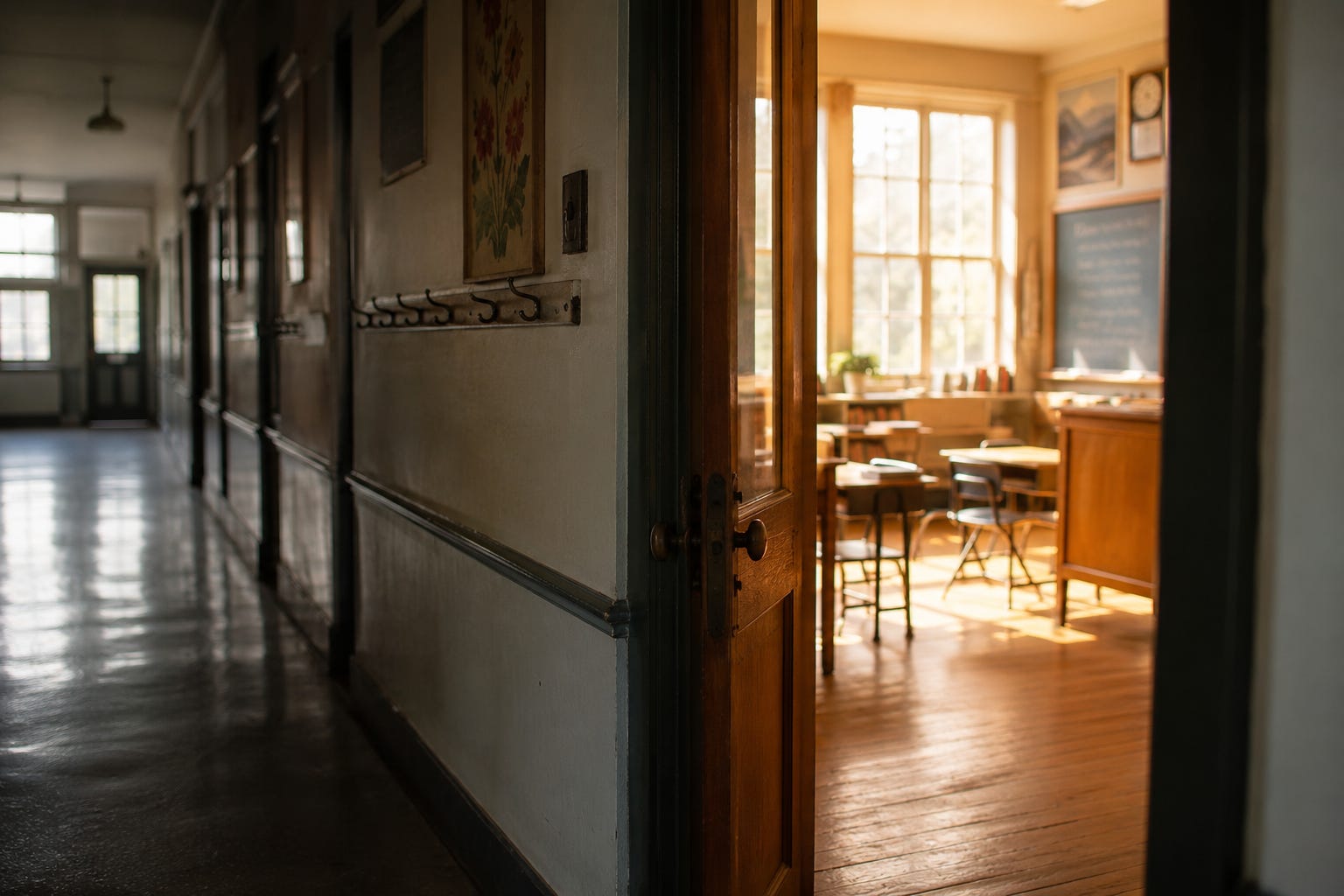
Before Writing in the Dark became an online home for thousands of readers, there was another kind of room. A classroom. Jeannine has spoken about a period when her life was coming apart while she was teaching at a Waldorf school. Each day, she would step into the classroom, close the door, and begin again. In a profile, she says teaching in that environment shaped her deeply, and she also describes Writing in the Dark as an “open door,” a safe creative space where people can be vulnerable together.
There is something very moving about that image. Not because it is dramatic, but because it is not.
Sometimes survival looks like a person walking into a room and closing the door. Sometimes it looks like deciding, for the next hour, to give your full attention to the people in front of you. Sometimes it is not a grand new life, but a small protected space inside the life you already have.
Maybe that is where the spirit of Writing in the Dark began before it had a name. In a classroom. Behind a door. In the choice to make a space where something fragile could be taken seriously.
A child. A sentence. A beginning.
When the Room Moved Online
Years later, the room moved online. The name she chose, Writing in the Dark, does not try to cheer anyone up too quickly. It admits that the dark exists. It admits that writing often begins before we understand what we are trying to say.
But it also refuses to leave the dark empty.
In one post, Jeannine writes about “befriending uncertainty” and about writing as something more than self-expression or information. That phrase feels close to the heart of her work. She is not asking writers to perform certainty. She is asking them to stay close enough to the unknown that something alive might appear.
This is also why her exercises feel so central to the world she has built. They are not just casual prompts tossed into the air. She has written that the exercises come from years of teaching and from her study of how attention, playfulness, constraints, and surprise can reshape the writing process.
“The exercises are not just writing prompts.”
I like that because a prompt can be a topic, but an exercise is more like a vessel. It gives shape to what might otherwise spill everywhere. It says, start here. Use this object. Follow this sound. Stay close to this scene. Do not explain too quickly.
Many writers wait for freedom before they begin. A free afternoon, a clear mind, a perfect idea. But freedom can be too wide. Sometimes what saves the writing is a small door.
A rule. A form. A limit.
Through that little door, the real voice may slip in sideways.
Fragments That Still Shine
The more I read about Jeannine, the more I feel that her work is built around one quiet belief: broken things are still allowed to shine.
Her author site describes The Part That Burns as a memoir that moves through childhood memory, trauma, motherhood, the body, and the longing for love. That same texture seems to run through Writing in the Dark. The work does not ask people to turn pain into a neat lesson. It asks them to look closely enough that the pain becomes part of a larger truth.
That is a very different kind of tenderness.
It is not soft because it avoids difficulty. It is soft because it makes room for difficulty without making people disappear inside it. Jeannine’s warmth has backbone. It is the warmth of someone who knows the cold is real and still believes in making a fire.
Maybe this is why the community around her work feels less like an audience and more like a gathering. People are not only coming to collect advice. They are coming to remember that writing can still be a way of returning to themselves.
The Tenderness of Staying
There is another kind of image around Jeannine that I find lovely: the ordinary work of making a life. Profiles mention baking, lake cabins, family, painting, hauling, teaching, and writing. These details matter because they keep the story from floating away into abstraction. She is not only a writer in the romantic sense. She is someone who makes things with her hands, carries things, tends things, returns to things.
That makes her creative life feel more believable to me.
There is a tenderness in her work, but it is not fragile. It is a tenderness that has done chores. It has packed boxes, taught classes, raised children, written sentences, revised pages, and kept going through seasons that did not feel easy.
Maybe that is why she can create a space that feels both gentle and serious. Her kindness does not say, anything is fine. It says, I know this is hard, and I will not look away.
That is a rare kind of encouragement. It does not flatter the writer. It steadies them.
The Light Left for Someone Else
Jeannine Ouellette’s story makes me think that writing is not always a path out of the dark. Sometimes writing is the small light we carry while we are still inside it.
She came through silence, memory, motherhood, classrooms, books, and years of teaching. She turned those things into language. Then she placed that language in front of others, not as a performance, but as an invitation.
You can begin here. You do not have to be finished. You can bring the part of you that still does not know. You can become slowly.
That may be the most beautiful thing about her work. Not that she built something large, though she did. Not that many people now gather around her writing, though they do. But that the space still feels like a room with a light on.
A person might enter and not become brave right away. They might not write something good that night. They might only sit there with the page open, listening to the old fear and the small hope living beside it.
But maybe, for the first time in a while, they do not feel completely alone.
And maybe that is where writing begins.
Not with confidence. Not with certainty. Not with a perfect sentence.
Just someone sitting down in the dark, seeing the lamp is still on, and reaching for the page.
Thank you so much for reading this far.