


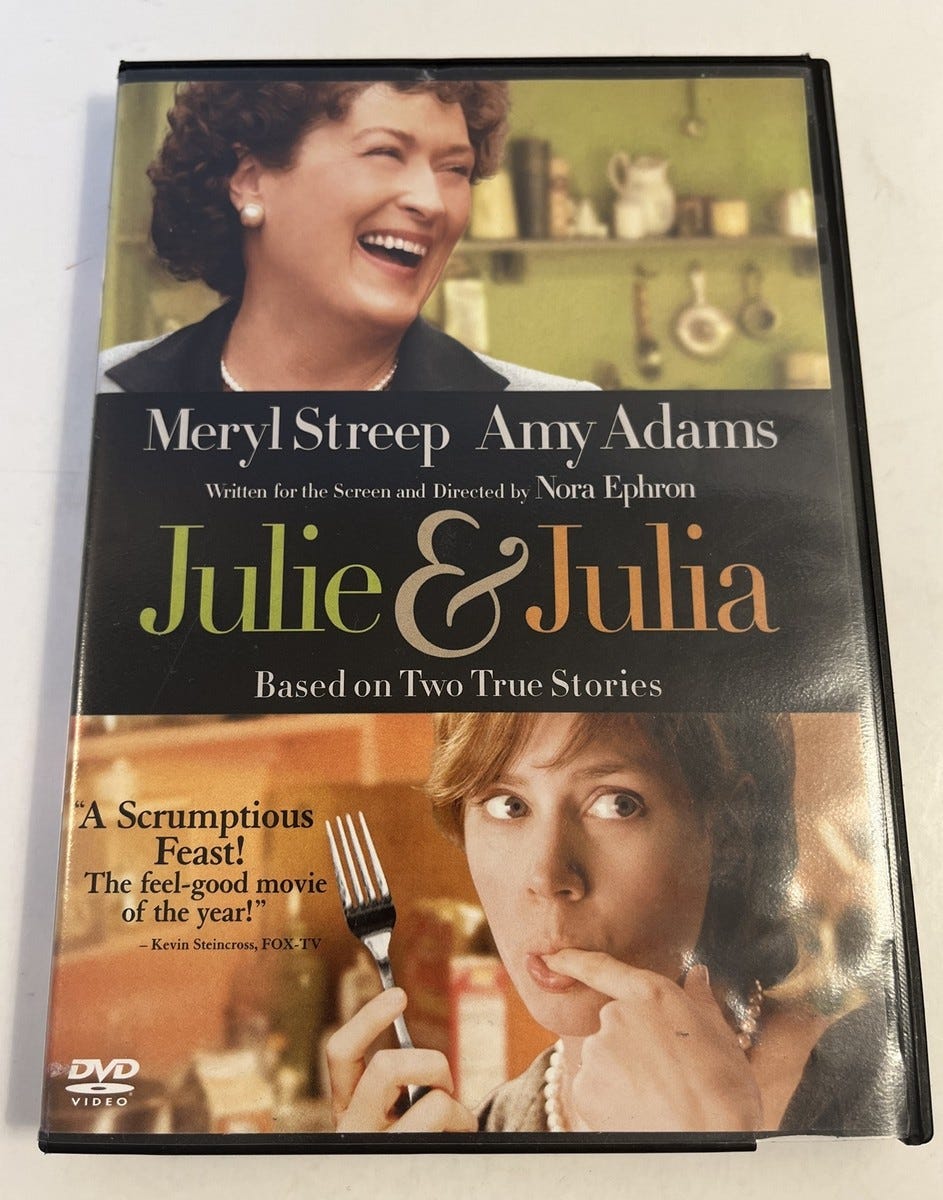
I want to bring you into a movie about food, writing, and ordinary life.
Julie & Julia came out in 2009. It runs two stories side by side.
Julie is in her late twenties in the early 2000s, answering phones at the Lower Manhattan Development Corporation after 9/11. People call to vent; she listens and realizes she can’t actually change anything for them. Deep down, she is a frustrated writer, though with only half an unpublished novel to her name, she can barely bring herself to call herself a real writer.
Julia is in Paris in the 1950s, the wife of a diplomat. She doesn’t need a job, but she wants something to do so she doesn’t feel lost in a foreign city.
They are different people. Julie is anxious and full of second thoughts. Julia is direct and enthusiastic. What they share is the sense that ordinary life has no real foothold. For Julia, French lessons are dull; the food is the only thing that interests her. For Julie, the kitchen is the one place in her day she can control. Food becomes the thing both of them can actually work on.
Julia enrolls at Le Cordon Bleu. She is the only woman in the class.
She starts slowly and improves fast. Her husband supports her; he doesn’t treat it as a hobby that a diplomat’s wife should drop. After she finishes the course, she decides to write an English cookbook—born out of her own frustration with being unable to find a decent French technique guide in English. She wants to explain things carefully enough for American home cooks.
Julie, meanwhile, has pretty much given up on ever becoming a writer. Her husband suggests she start a blog—then a new enough form that she doesn’t need anyone’s permission to publish. She is looking for one thing she can finish, something that might prove she isn’t as stuck as she feels. She realizes that by cooking her way through Mastering the Art of French Cooking, she can bring together the quiet safety of her kitchen and her deep love for writing.
Julia’s book takes nearly a decade. She wants the instructions detailed. While she is writing, her husband’s posting ends. They face the real threat of being reassigned elsewhere—leaving France could mean the end of the cookbook. Luckily, his next assignment is merely to the south of France, allowing her to keep the project alive.
Julie sets a deadline: 524 recipes in one year. That’s brutal. Most of the dishes take real time. She still has a day job.
When Julia finishes the manuscript, Houghton Mifflin turns it down. Even the endlessly energetic Julia began to doubt herself: “This isn't even a real book... maybe I should just drop it.”
The book is too long. At the time, American cookbooks mostly taught quick shortcuts, how to cook with canned soup and marshmallows. To publishers chasing trends, Julia’s meticulous instructions just looked like unnecessary wordiness. As luck would have it, an editor later finds the rejected manuscript, cooks from it, and likes the results. She brings it to Knopf. The book is published in 1961. It is called Mastering the Art of French Cooking.
(A quick side note: if you remember our piece from last time on how book editors shape culture, this is a prime example of why great editors matter.)
On Julie’s side, the first hundred-odd days of the blog produce almost no response. No comments, no readers she can see. Then a single notification popped up. She clicked it with excitement—only to realize the very first reader was her mom. Before long, her persistence finally paid off. Amanda Hesser of The New York Times notices the blog, visits, and writes about it. Readers arrive quickly after that. The project stops feeling like pure self-discipline.
Julie and her husband start arguing. She is spending more time on the blog and less on him. After one fight he leaves. She keeps cooking and posting, but the posts change; she writes about missing him and realizing how much he had been doing in the background. A few days later they meet outside a pizza place near their apartment and make up. Then she learns that Julia, by then in her nineties, has heard about the blog and does not want to meet her. Julia thinks the project is not serious—how can someone cook all those recipes so quickly? Julie is shaken. The book had given her a clear task in a flat period of her life. She had treated Julia as an idol. The rejection does not last long in her mind. She decides that Julia was simply someone who followed her own idea of what was worth doing, and that she is doing the same thing.
The movie ends there. It is light. It does not argue a large point. It is about two women who found a way to make ordinary days more interesting through food and writing.
What were the people who made it thinking?
Sony saw a few elements that were already popular: blogs, young people escaping dull jobs, women taking action, and food. It’s much like how Netflix packages content today, combining proven ingredients to minimize commercial risk. The formula worked well enough at the box office.
Nora Ephron wrote and directed the film. It was the last one she did. She said she did not have a larger idea in mind and was not interested in the food politics of the moment. The reason she wanted to make it was simple: just to celebrate. To celebrate that good food exists, and that wanting a better ordinary life can make things taste better.
Meryl Streep, who played Julia, said she was trying to show the same open, energetic quality her own mother had.
“Just to celebrate.”


The phrase stayed with me for a while.
Later I learned a few things outside the movie. Julia passed away a few years before the film was made. Julie’s marriage later faced severe trouble; she wrote a whole book about the chaos.
The phrase is still sitting there. It is the cleanest reason for making something that I have come across. Life is complicated and hard to predict. Celebrating what is already good is a plain way to live inside it.