

Walt Disney Hit Rock Bottom — Then Created the Mouse That Made the World Laugh
At the lowest point of his life, Walt Disney bet on a mouse nobody had heard of.

Hey fellow Stackers,
Recently I came across a cartoon — a little mouse standing at a ship’s wheel, whistling. I watched it, and it still got me laughing.
So I got curious and went looking into how it came to be — and I want to share it with you: that mouse, and the creator behind the idea, Walt Disney.

Losing Oswald
Oswald was a character Walt created with his animator Ub Iwerks — a lucky rabbit: quick, restless, forever getting into trouble and always slipping back out of it. Walt gave him the name “Lucky Rabbit”, hoping the character would become a good omen for the young studio. When Trolley Troubles reached theaters, audiences loved him, and Oswald became the studio’s first real hit.
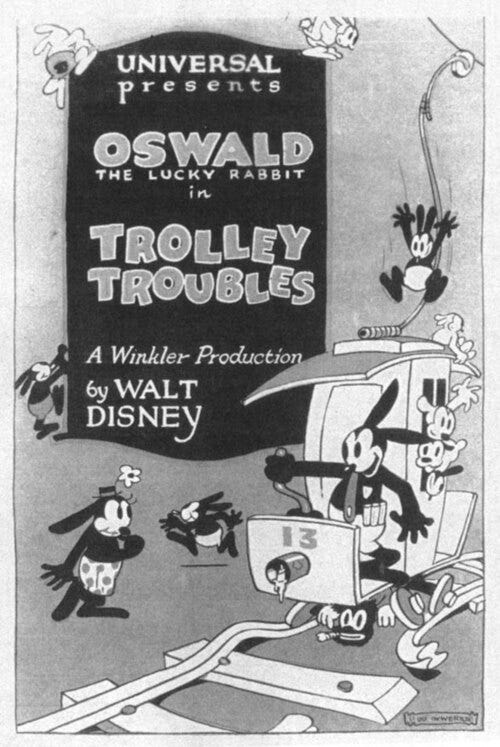
Early in 1928, Walt took the train to New York with his wife, Lillian. The trip had one purpose: to secure a bigger production budget for the next run of Oswald cartoons. In his mind it was as good as done — Oswald was selling, the films kept getting better, and asking for a little more to make them seemed only reasonable.
Then he sat down across from his distributor, Charles Mintz. Instead of the easy renewal he expected, Mintz slid a new, worse deal across the table. He didn’t just want Walt to take a smaller budget — he wanted Walt to come work under him, as a salaried employee. Before Walt could recover, Mintz laid out the rest of his cards. The rights to Oswald had belonged to Universal from the start; they were never Walt’s. And most of Walt’s own animators had already quietly signed with Mintz. He said it evenly, without raising his voice, and left no room to move: take the cut, or he didn’t need Walt at all — he could keep making Oswald without him.
Walt didn’t haggle, and he didn’t plead. He heard Mintz out, stood up, said no, and walked out the door.
It was only walking out that door that he felt the full weight of what the trip had cost him. He'd come east sure of himself, never guessing the people around him had already turned their backs. Years of work had been pulled out from under him in a matter of weeks.
The Birth of Mickey Mouse
On the long train ride back to California, Walt began turning over a new character — one that would be entirely his own. He thought back to a little mouse he’d known around an early studio, and that faint old impression became the first shadow of the new one.
He wanted to call it Mortimer. Lillian thought the name too stiff, better suited to some elderly gentleman, and said Mickey sounded livelier — more like a mouse that got into trouble. Walt agreed at once.
This time, the mischievous little mouse was his.
Back in Hollywood, nearly all his artists were gone. Only Ub Iwerks stayed. The two went back to their Kansas City days; they’d started Laugh-O-Gram together, failed together, made Oswald together. When better money lured the others away, Iwerks stayed put.
Walt worked out who Mickey was, and Iwerks made him real on paper. The earliest Mickey — his movements, his face, that spark of life — came out of Iwerks’ pencil, line by line.
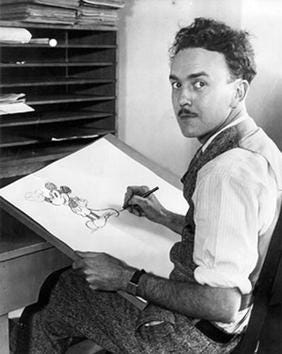
The design was almost nothing but circles: a round head, a round body, two bold round ears — easy to recognize, easy to draw. But what brought him alive wasn’t the shape. It was the personality Walt gave him: curious, mischievous, unafraid of trouble; the smallest one in the room, and the first to walk toward whatever went wrong — a lot like the man who drew him.
The idea from the train slowly came to life on paper.
They Don’t Know Your Mouse
Mickey was born, but success didn’t come with him.
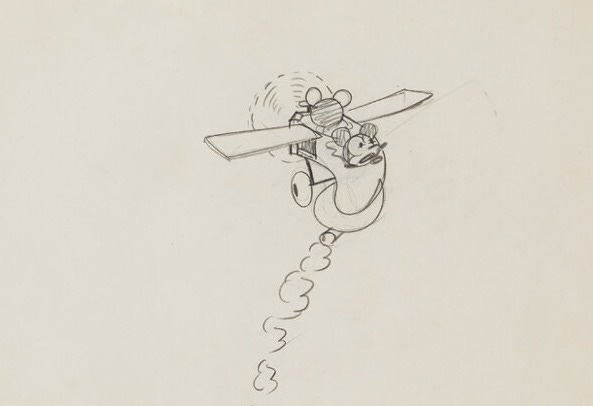
The first film was Plane Crazy — a mouse who wanted to fly, riding the excitement around Lindbergh’s flight across the Atlantic. In May 1928 it was previewed, silent, for a small audience. Walt had no distribution of his own, and Mickey was a face nobody had seen; one distributor after another watched it and passed on an unknown mouse.
He didn’t give up. He rushed out a second film, The Gallopin’ Gaucho, hoping a different story might open a door. He carried the reel to the same distributors and got back the same answer — no takers. The same waiting, the same politeness, the same shake of the head, until he could almost say the rejection for them.
The distributors were blunt:
They don’t know you and they don’t know your mouse.
Both films had failed, and the money for them was gone — not a cent of it back. In his brother Roy's ledger, every dollar spent on these Mickey shorts was set down to the penny: Plane Crazy, $3,528.50; The Gallopin' Gaucho, $4,249.73 — and for a studio that could barely keep its lights on, that was nearly the last of everything it had, filled in cent by cent. The money had run dry, and the mouse Walt had poured his whole heart into still had no takers — the distributors' “they don't know your mouse” was like a door that wouldn't budge, shutting Walt and Mickey out together.
But Walt and the few who’d stayed weren’t ready to quit. Not long before, Walt had seen The Jazz Singer. Pictures that talked and sang were making silent films feel old overnight. Walt decided to give his cartoon sound — not music laid under the picture, but sound that was part of the action itself, part of the storytelling.
That film was Steamboat Willie.
Steamboat Willie
Before the film was even finished, Walt ran a test at the studio.
To keep the machine’s noise out, they set the projector outside the window and shone it back through the glass. The picture landed on a bedsheet hung up inside, faintly glowing, swaying in the draft. The animators crowded behind the sheet, watching Mickey’s movements through the shadow and scrambling to make the simplest sounds by hand — a harmonica for the tune, Walt screeching Mickey’s squeaks, someone grabbing whatever was in reach to keep the beat. On the other side of the sheet, a few of the men’s wives had pulled up chairs in the front row: the first audience in the world.
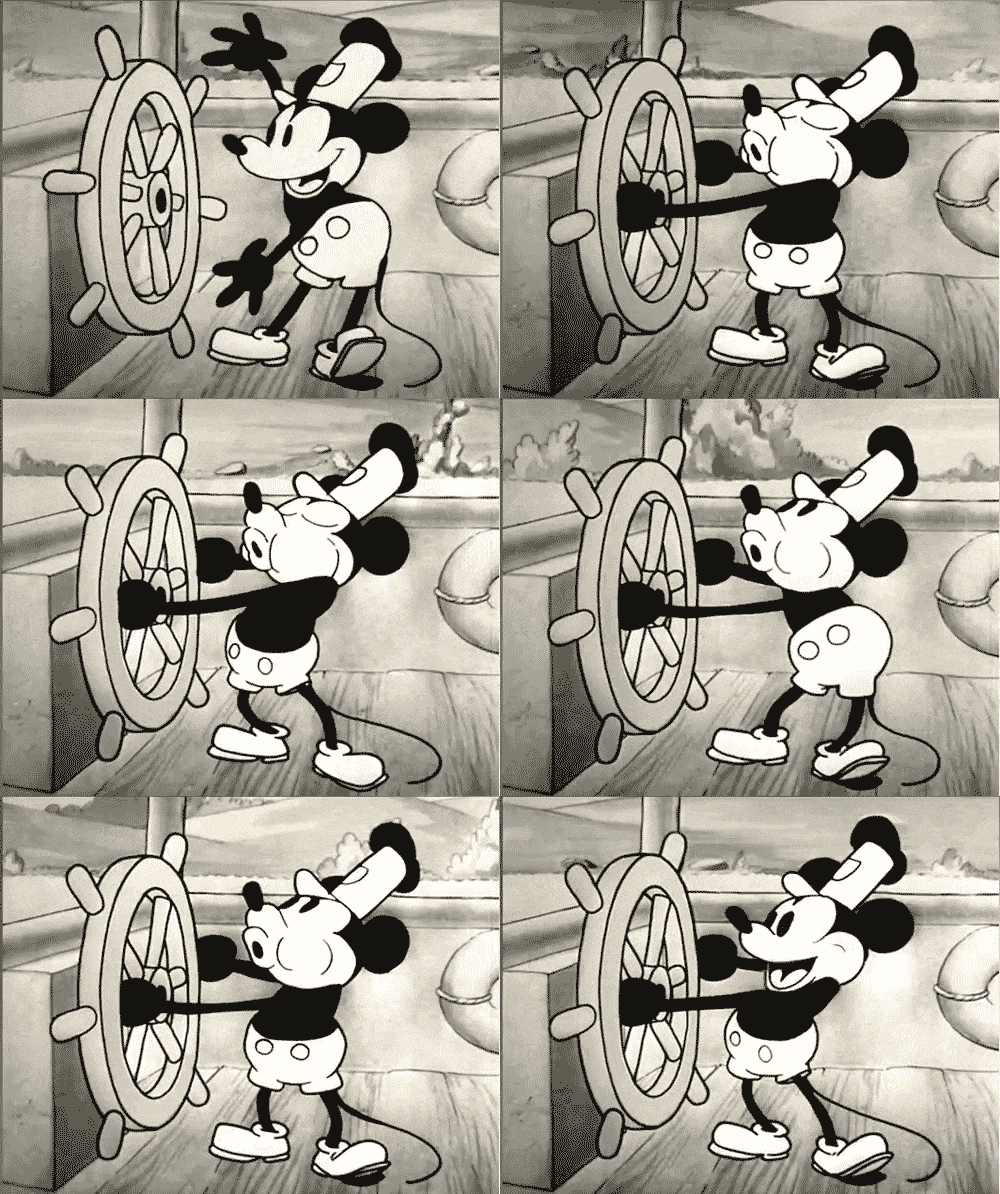
The effect caught them all off guard. On screen, Mickey stood at the wheel whistling, bobbing along with the boat’s whistle; in the second half he banged out sounds on everything within reach. The moment image and sound clicked together, the people on both sides of the sheet reacted almost by instinct. Walt later said that screening was “like an electric shock.”
He carried the finished film to New York to give it a real soundtrack, hiring a seventeen-piece band and a sound man on money scraped together from everywhere. It was harder than he’d imagined. The band couldn’t stay with the picture; the beats slipped again and again — Mickey clearly banging a pot, the sound landing half a beat late — and the money burned down. The first session fell apart.
To keep going, Walt sold his car. Then they tried a plodding little trick: marking the beat frame by frame along the film so the players could follow the picture note by note. One sound at a time, image and sound finally locked together. Walt had proven what he set out to prove — sound could give a picture life — and that was enough to make a distributor give this unknown mouse a chance.
A Room Full of Laughter
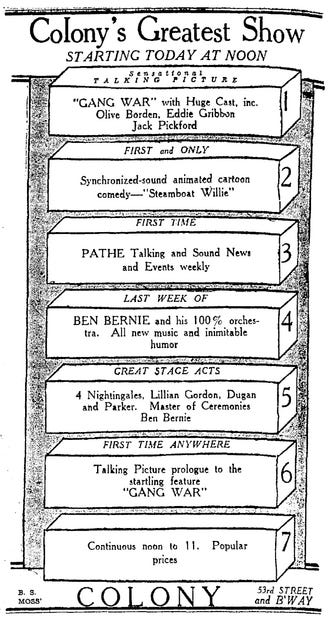
On November 18, 1928, Steamboat Willie opened at the Colony Theatre in New York.
The screen lit up. Mickey stood at the wheel, whistling along with the steamboat’s whistle, ears and tail and heels all keeping time, the whole boat seeming to bob to his tune. He didn’t get to strut for long: the big, sour Captain Pete came stomping over, plucked the little mouse off the wheel, and shoved him off to do the dirty work.
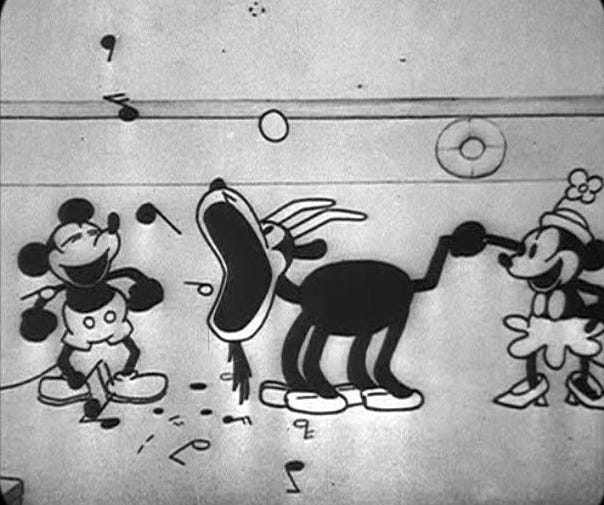
Then the real fun began. When a goat swallowed Minnie’s sheet music and ukulele whole, Mickey didn’t miss a beat — he cranked the goat’s tail like a hand organ, and out of its wide-open mouth wheezed an off-key “Turkey in the Straw.” A live goat, turned into a phonograph. From there he pressed the whole boat into service: a yank of the cat’s tail for a screech, a squeeze of the sow for an accordion — goose, piglets, cow, not one of them spared, every last one cranked into an instrument. The whole boat was in an uproar, but Mickey just whistled and kept the beat, turning the chaos into one tight, rollicking tune.
The audience had never seen a mouse like this. It started as a few scattered laughs and quickly ran into one solid wave — knees slapped, people doubled over, the laughter rolling over itself. The sound didn’t feel dubbed onto the mouse; it felt like the mouse was making it, right there in front of you — and joy like that is contagious.
The next day, one reviewer put it simply:
It is impossible to describe this riot of mirth, but it knocked me out of my seat.
From One Theater to the World
The laughter from that night at the Colony didn’t stay in that one room. Soon it spilled past the city and carried far beyond it.
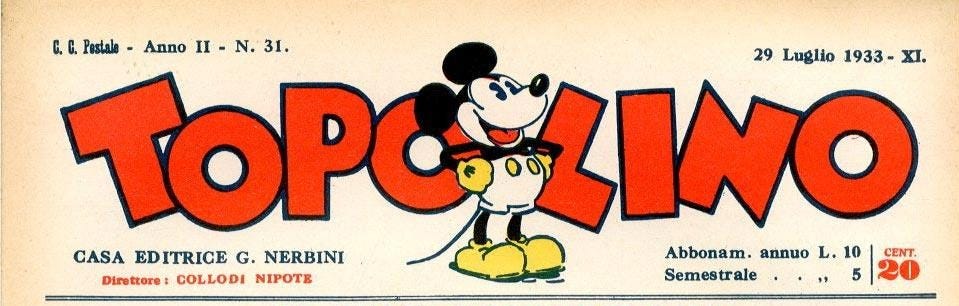
Mickey’s comedy needed no translation. His gags had almost no dialogue — it was all banging, yanking, hopping; a joke made of body and rhythm. So when the reels crossed the ocean and lit up screens in London, Paris, and Tokyo, audiences who couldn’t follow a word of English laughed in exactly the same places. Mickey even picked up his own names along the way: Topolino in Italy, Micky Maus in Germany — but whatever the language, the one making them laugh was the same mouse.
And that laughter happened to land in the years that needed it most. Just as Mickey was catching on, the world outside was caving in. The 1920s, when everything seemed to be climbing, ended in the fall of 1929 — the market crashed, banks closed, factories went quiet; the good times that were supposed to last turned into breadlines around the block and one letter after another that read, Sorry, no work.
The harder the years got, the more people needed something to laugh at — and that was exactly what Mickey gave them. He was only a mouse with no power and no standing, the smallest one around and the one in the most trouble, hauled up and kicked around by the enormous Pete again and again. But he never stayed down. He’d rig something out of whatever junk was lying around and, a moment later, be whistling and strutting all over again. To the people in the dark below, scraping through their own weeks, that was the very thing they wanted to believe about themselves: no matter how bad it gets, you can still laugh. A few cents and a seat in a dark theater — those few minutes were, for a lot of people, the only ones all week they still laughed out loud.
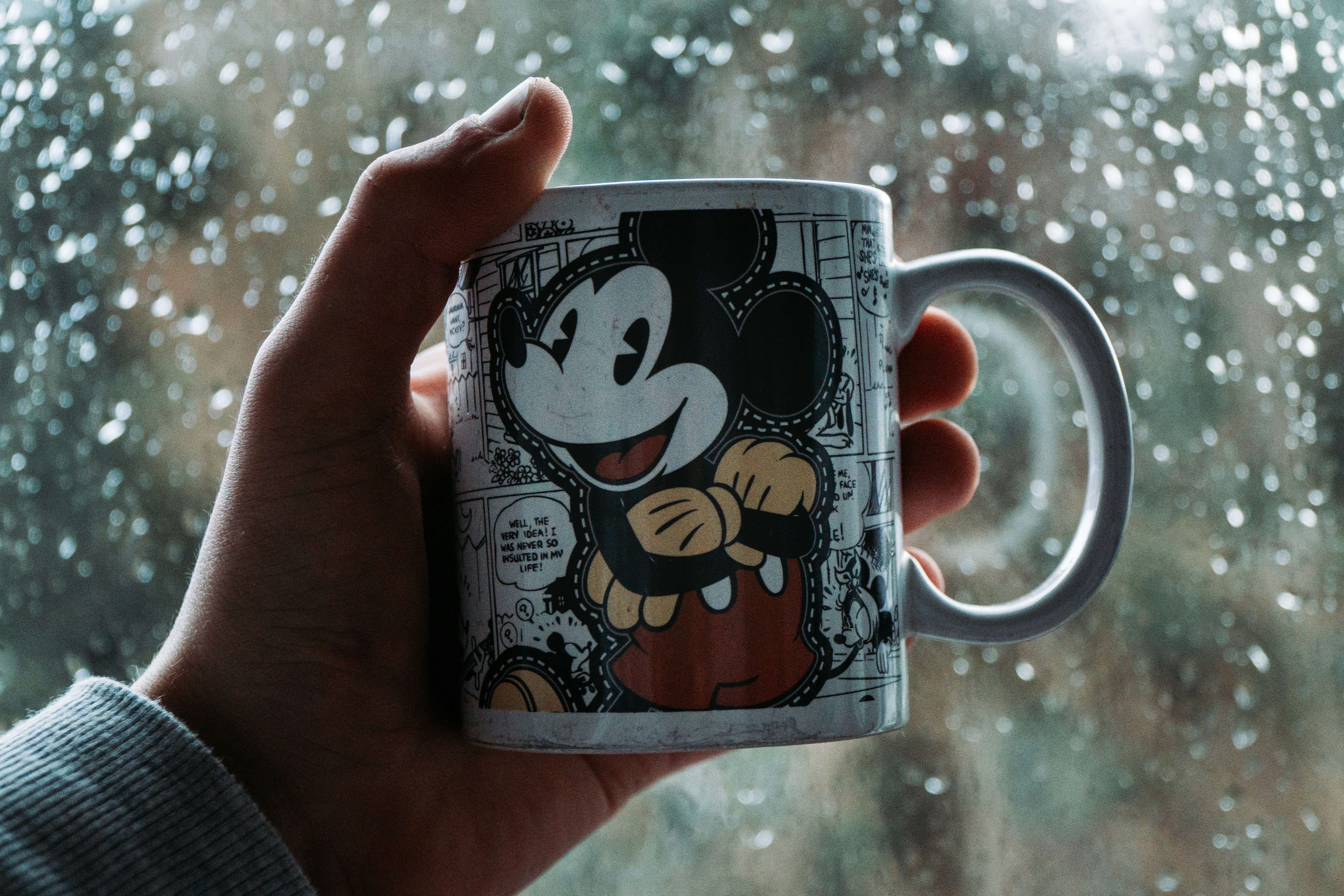
And Mickey’s joy didn’t stay in the theater either. From 1930 he climbed onto the newspaper page, getting into and out of trouble in the morning comics, good for a laugh over a cup of coffee; even the week you couldn’t make it to a theater, you could still find him in the corner of the paper. Before long he stepped off the page and the screen and became something you could hold — dolls, toys, and the 1933 Mickey watch that landed on the counter at Macy’s and sold eleven thousand in a single day. To bring Mickey home was to carry that laughter out of the dark theater and into your own days.
Once, Walt had gone looking for a Lucky Rabbit to bring his studio luck. He never got to keep that rabbit. The luck came instead from the mouse he drew at the lowest point of his life.
That mouse carried his laughter to places Walt himself would never reach, onto faces he would never know. What stayed on the screen was a mouse he’d drawn with his own hands — one that made the whole world laugh.
His name was Mickey.
Oh dear! Mickey mouse
How I wonder where you are
Where I was young I drew your art
But now, where thou at.
I live watching Mickey mouse 😄
Thanks for bringing this back
Best and refreshing article i read today.
Thanks for sharing a back story of Mickey
He filled my childhood with laughter.
Just highlighting this part
That mouse carried his laughter to places Walt himself would never reach, onto faces he would never know. What stayed on the screen was a mouse he’d drawn with his own hands — one that made the whole world laugh.