


Hey, fellow Stackers 👋
When you see a flying scene in an anime, which creator comes to mind first? For me, it’s Japanese animator Hayao Miyazaki.
Miyazaki was born in 1941 into a Japanese manufacturing family. His family’s factory produced parts for military aircraft. Growing up around airplanes gave him a deep fascination with them, and flying became a lifelong love. At the same time, airplanes were being used on a massive scale for war, becoming tools for dropping bombs and taking lives.
Miyazaki loved the beauty of airplanes, while also opposing the destruction they could cause when turned into weapons. That tension drove him to keep exploring what flight meant to him. Of the 12 animated feature films he directed, 10 contain scenes of flight. He even named his studio Ghibli, after a word associated with a hot desert wind from the Sahara.
In Nausicaä of the Valley of the Wind, released in 1984, flying is Nausicaä’s way of getting closer to the world around her. It is a devastated world after war. The land is covered by the Sea of Corruption, whose plants release poisonous gases. Giant insects called Ohmu live there, terrifying the humans who remain.
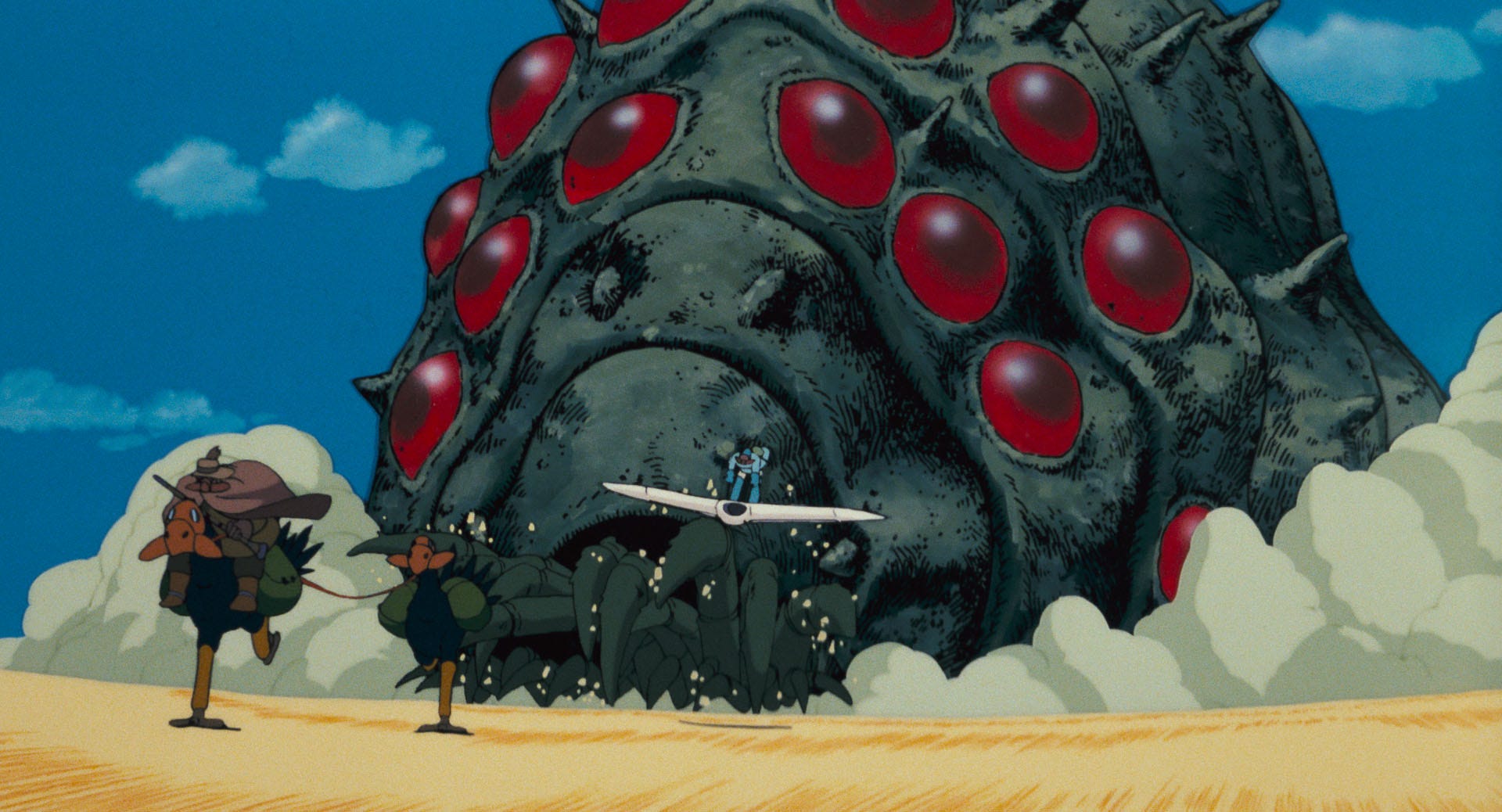
But the Sea of Corruption that frightens everyone else is a kind of paradise to Nausicaä. She flies her glider through the toxic forest, collects plant samples, observes the Ohmu, and tries to uncover the secrets of the Sea of Corruption.
Eventually, she discovers that the real poison comes from polluted soil and water, not the plants themselves. The plants of the Sea of Corruption are slowly cleansing the land. Riding the wind above the forest, Nausicaä searches for a way for humans and nature to coexist, somewhere between the sky and the earth.


In Porco Rosso, released in 1992, flying becomes a way to keep a distance from the world and stay away from war. High above the deep blue Adriatic Sea, a flash of red moves effortlessly through the clouds. It is Porco Rosso’s red seaplane.


Porco was once an ace pilot in the Italian Air Force. During a dogfight, he passed out after entering a cloud. When he woke up, he saw his dead comrades flying one by one into the sky. In the end, he was the only one left, flying alone above the clouds. After that, he became a pig.


Later, Italy fell under a fascist regime. Porco left the military and settled on a remote island, making a living as a “bounty hunter” in the Adriatic, taking on jobs to fight air pirates. When a former comrade urged him to return to the Air Force, Porco refused: “I’d rather be a pig than become a fascist.”
What happens when the dream you love becomes a tool that hurts other people?
In 2013, The Wind Rises was released. The film tells the story of Jiro Horikoshi, whose dream is to design a beautiful airplane.


This was Japan during World War II, when almost all of the aviation industry’s resources were directed toward developing fighter planes. For Jiro, the only way to pursue his dream was to design military aircraft. He poured everything into refining their lines, making them fly farther and faster, while giving them a graceful shape. But the better the plane performed, the greater the damage it could cause.
When the war ended and Japan was defeated, all the planes Jiro had designed were left scattered across the land as wreckage. Just as Caproni tells Jiro in the film, planes are beautiful dreams, but cursed dreams too, waiting for the sky to swallow them.


In his proposal for The Wind Rises, Miyazaki wrote: “Dreams contain an element of madness, and we must not hide the poison within them. The desire for beautiful things can destroy you. Pursuing beauty may come at a cost.”
Miyazaki’s thoughts on flight are reflected not only in the stories he tells, but also in the way he draws them.
He personally took part in designing and drawing the aircraft in his films. He also paid close attention to the experience of flight itself: the path of a glider cutting through the wind, the roar and vibration of an airplane engine, the way a fuselage tilts in the air.


He paid attention to wind, weight, speed, and inertia in flight. He also thought carefully about how animation should make flight feel real.
He developed two basic ways of framing it. One is a “moving point of view,” where the camera follows the aircraft so the audience flies alongside the characters, feeling changes in altitude, speed, and the landscape below. The other keeps the camera relatively still, allowing the aircraft to sweep across the frame.
Miyazaki loved flying, and flying fueled his creative passion. At 38, he independently directed his first animated feature, Lupin III: The Castle of Cagliostro. Near the end of the film, Jigen Daisuke flies a propeller plane into the castle. It was the first time flight had made its way into one of his feature films.


After The Wind Rises was released in 2013, Miyazaki, then 72, announced that he would no longer make feature-length animated films. But he could not let go of creating, and in 2023, The Boy and the Heron was released. This time, flight became a passage between life and death — a boy named Mahito, guided by a heron, enters another world and meets his late mother.
From the age of 38 to 82, flight appeared again and again in Miyazaki’s work. It carried his personal ideas and feelings, gradually becoming an image he could never let go of — his personal signature.