


This week’s list:
1. Interview: Shigeru Miyamoto on 50 years of creation.
2. Creative Bits
Interview
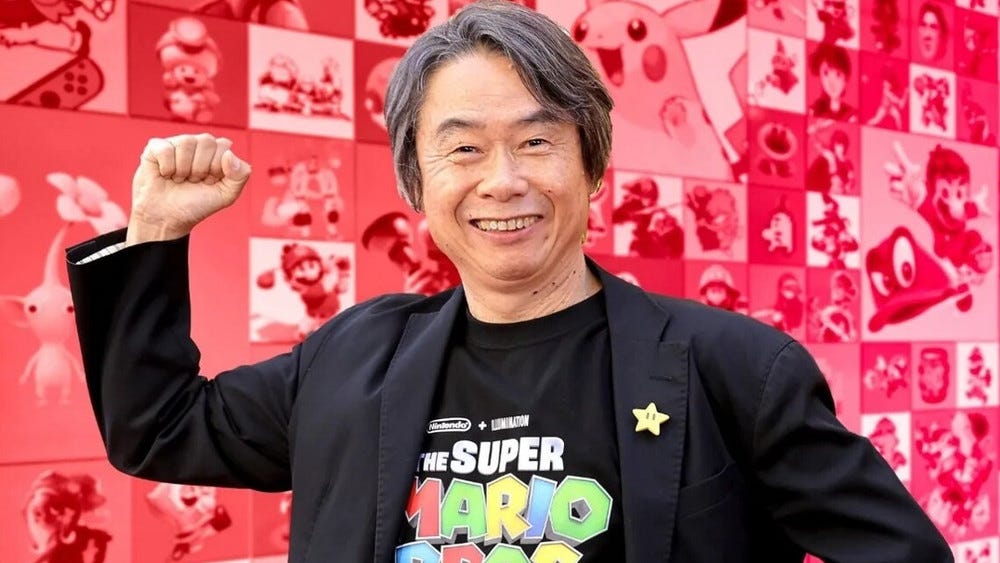
Last week, legendary Nintendo designer Shigeru Miyamoto was awarded Japan’s prestigious Medal of Culture. Following the announcement, he held a press conference at Nintendo’s headquarters in Kyoto.
Stepping up to the podium looking slightly shy and flustered, yet smiling warmly, he said: “Receiving such an incredible honor makes me feel deeply humbled and proud. As I often say, I didn’t build any of this alone—it was forged together with so many talented people. So, I am simply here today accepting it on everyone’s behalf.”
Born in Sonobe-cho, Kyoto Prefecture (now Nankantan City), Miyamoto graduated from the Kanazawa College of Art with a degree in industrial design in 1977, walking straight out of graduation and into Nintendo. He went on to create Donkey Kong, Super Mario Bros., The Legend of Zelda, and other pillar works that laid the absolute foundation of both modern gaming and Nintendo itself. He is, without a doubt, one of the most defining creators in the history of the medium.
This year marks Miyamoto’s fifty-first year making games. With a characteristic chuckle, he joked: “I joined Nintendo in 1977, and games took off right after that, so I suppose it’s really been 50 years. Next year makes 51, but for the sake of a clean number, let’s just call it 50 today.”
Amidst the Q&A session, he looked back on half a century of craft. Here are some excerpts I’ve pulled to share with you.
Q: This award feels symbolic of how gaming’s place in society has shifted. How do you view the role of games in culture today, and where should they go from there?
A: Back when I was a kid, we had toys like “baseball boards,” diamond games, rocket games, and Hyakunin Isshu card games. I’ve always felt that Nintendo shared a very natural relationship with everyday life.
Once we started making electronic games, my vision was clear: “There’s always a game console in the center of the living room, where everyone gathers.” That felt very Nintendo to me. So I never wanted to build games exclusively for hardcore gamers; I wanted to spark curiosity in people who didn’t play games at all.
When I was 27 or 28, most people my age weren’t playing games. Over time, that shifted into an era where “dads grew up playing games,” and now, “grandpas grew up playing games.” Today, three generations of a family understand games. Seeing it embraced as a genuine part of culture brings me immense joy.
Moving forward, I want to keep making things that even people indifferent to new media will naturally pick up—things that anchor themselves right in the center of the living room.
I love the phrase “the center of the living room.” It implies that creation is fundamentally about joy meant to be shared with family and friends.
Q: Like many around the world, my life has been shaped by Nintendo’s worlds. Could you say a few words to Nintendo fans globally, and share your outlook for the future?
A: A few years ago, we finally started making movies. I used to be quite stubborn about it, saying, “We don’t make movies.” Because making a movie requires telling a story, and storytelling demands rigid definitions: “This character has this specific personality,” “They live with these family members,” and so on. But we always created characters strictly for games. Since we never knew what game we’d want to make next, locking down hard lore in advance felt suffocatingly unfree.
So I used to say: “These characters exist for games, and they stay in games.” But after all these years, people calling themselves Nintendo fans genuinely love these characters. Mario, Kirby... we’ve brought all sorts of characters to life. I began to realize that you don’t even have to play the games to be a Nintendo fan—loving the character alone is enough. That realization clicked, and I thought, if we’re going to do it, we’ll do it ourselves. That’s how the movie production started.
Beyond that, we’ve expanded into theme parks. It’s no longer just about games; the characters born from our games are finding ways to reach wider audiences through all kinds of collaborations. Look at how hard Pikmin Bloom is working right now. That wasn’t even developed in-house at Nintendo; it was built by the team at Scopely Explore, yet we’re partnering up to bring Nintendo characters to life on mobile devices, too.
In my experience, artists and creators are notoriously rigid. But when they finally decide to pivot, they do so with breathtaking speed and absolute sincerity.
Q: Could you talk about your feelings toward your hometown of Sonobe and the city of Kyoto?
A: I’m from Sonobe-cho in Nantan City. Back then, it was such a rural place that “going into Kyoto city felt like a major expedition.” I went to college in Kanazawa. Because I studied design, people around me would say things like, “If you’re doing industrial design, you have to go to Italy!” or “New York is the only place that matters!” Yet I ended up settling down and finding a job in Kyoto, slowly making things at my own pace.
Around the time I hit 30, people warned me, “If you aren’t in a cutting-edge metropolis, a designer’s well will run dry.” I didn’t pay much attention and just kept creating.
By the time I passed 30, I noticed our overseas sales were starting to eclipse Japan’s. By 40, people started asking me, “How on earth do you make things like that?” That was when it hit me on multiple levels: Ah, staying in Kyoto was the best thing I could have done. Instead of fighting in the rat race, I was able to take my time and craft things properly.
Sonobe is much the same. Growing up surrounded by Sonobe’s nature—all of those childhood experiences bleed into every decision I make today. Running wild through nature as a kid, those memories naturally resurfaced, and perhaps that’s why they resonate with people all over the world.
Cultures differ, but the physical stimuli and cognitive sparks children experience are universal. As I’ve grown older, I’ve only grown more convinced: how lucky I was to grow up in the countryside, and how lucky I’ve been to live in Kyoto all this time.
It’s not as though any specific game was modeled directly after something in Sonobe. Rather, it’s the physical imprints carved into my body by Sonobe—climbing up hills and sliding down, catching fish in the river, nearly drowning—those visceral memories became the origin point of my creativity. In that sense, Sonobe raised me.
This was the most moving part of the piece for me: when creators go with the flow, they lose what is most precious—their unique perspective and perception.
Q: Nintendo will continue to cultivate new creators internally. How do you plan to pass your philosophy down to the next generation?
A: The only way is through daily work, communicating and building things together, step by step. But with around 10,000 developers across Nintendo globally now, instilling that core spirit of “originality” throughout the entire company gets harder by the day.
Even so, little by little, while crafting our next projects, we try to let the essence of “what true originality means” seep into the team. Right now, we’re actively gathering our mid-level leaders to create spaces dedicated to discussing these exact ideas. I’ll keep trying my best.
You can feel just how immensely difficult it is to sustain a living creative culture, even inside a team like Nintendo.
Q: You mentioned earlier that “time passing without you noticing” is the essence of play. Right now, generative AI is evolving rapidly, lowering the barrier to entry for making games, while raising questions about human talent and capability. How do you view the rise of AI in game development?
A: Our era coincided with the dawn of computing. Before that, we had typewriters, which evolved into word processors—tools were constantly evolving. Back in school, graphic designers were taught how to hand-letter poster typography with absolute precision. If you mastered that, you were a “designer.” Or you could take a trendy foreign design, tweak it to a Japanese aesthetic, and call yourself a designer.
It wasn’t until computers evolved and technology advanced that a person’s true layout intuition and individual design capability were truly laid bare. I think generative AI is facing that exact same turning point right now.
We separate “creation” from “busywork.” When you want to build something, you first outline the grand architecture, heading toward a specific vision. Everything after that is just busywork—filling in the empty holes, polishing the edges to make it look pretty.
The trouble is, busywork itself is fun. It gives you an immediate sense of satisfaction. But if you mistake the satisfaction of busywork for creating something genuinely good, that’s a dangerous trap.
In that sense, the more AI handles our busywork for us, the more it gives us a vital opportunity to ask: What is it that truly matters? And that’s a good thing.
In past design eras, people used to rely on pure copy-pasting. But designs like that never endure. Why? Because there’s no personal intent behind them. You need individual intent first, and then you let the computer help you with the heavy lifting—that’s the structural order. No matter how far AI evolves, and even if machines can do practically anything in the future, the things that only we can do will always remain.
Separating "creation" from "busywork" is the agonizing yet essential metamorphosis every creator must undergo.
Q: To you, what is a game?
A: Ever since I was a kid, I’ve found joy in making things and watching people’s reactions of sheer surprise. In middle school, I wanted to be a manga artist, and drawing comics for people to read brought me so much happiness. My parents used to barge into my room uninvited, so I built a rigged “haunted house” trap that would shock them the moment they walked in—they got furious, but I thought it was hilarious (laughs).
When I was doing industrial design, I wanted to build objects that sat on a table moving strangely, prompting people to ask, “Why is that moving?” and letting me reply, “I don’t know, but it just keeps going.”
When I started making games, someone asked me, “Who is your biggest rival?” I answered, “The Rubik’s Cube.” To an industrial product designer like me, it was an awe-inspiring masterpiece of design.
I stumbled upon video games precisely while searching for a way to build something like that, and I consider myself lucky. People drop coins into arcade cabinets, I suppose, because losing makes them frustrated. Not out of blind luck, but raw frustration—and games harnessed that exact human drive. Meeting video games was my ultimate piece of good fortune. As we expanded, my interest shifted away from simply “collecting coins over there” to wondering: Why do people want to come back and try again?
Just playing isn’t enough; what if it felt like “stepping directly into that world”—like a sekai-niwa (miniature box garden) game? Once you build the box garden, you start thinking: Wouldn’t it be even more fun if there was a story woven inside it? And that led to surrounding lore.
Even so, we aren’t traditional storytellers. The magic happens when players experience a journey where the story unfolds organically inside their own minds—figuring out how to build that kind of structure is what I’ve spent my life pondering. Ultimately, I’ve just spent my career seeing how the things I put out into the world get received, and for that, I feel deeply fortunate.
I didn’t enter Nintendo as a “game company employee”—I joined as an eccentric toy maker that had no idea what it would make next. I was very lucky.
Q: You’re known as the father of Mario. Could you share some behind-the-scenes stories from his creation?
A: Back then, there was Pac-Man. What kind of game was Pac-Man? You eat all the dots, clear the screen clean, and once everything’s gone, clear! Anyone can look at that and instantly understand it.
Then came Tetris: blocks tumble down from above, you wedge them in, and a horizontal row fills up and vanishes. Anyone can understand that instantly, too.
When I was making Donkey Kong, it was a bit harder to grasp. The concept of “this guy moving from Point A to Point B” didn’t have that instant visual clarity; it was tough to convey. There was no “clear the screen and look pretty” or “check all the boxes to win” framework. To make people understand where they needed to go, we had to invent a narrative: a gorilla kidnaps a girl and runs away, and you have to chase after him.
At the time, I kept thinking: If only the screen could continuously scroll, letting you venture further and further out. But the technology back then didn’t support scrolling. Even so, the dream remained: What if we could build a game where a jumping Mario could just keep running forever and ever? That was the initial foundation.
We added things piece by piece: eat a mushroom and grow big, get hit once and you’ll be fine... bit by bit, it evolved into Super Mario. Back then, I talked about “Land, Sea, and Sky”—humans run, so what if we let them run on the ground, swim through the ocean, and fly through the sky, executing everything through pure action? That, I suppose, was the invention.
Everyone wants to try that, right? Running sideways, flying through the air, swimming. When you’re sitting on a train, haven’t you ever traced your fingers along the window, imagining a little guy running and jumping over a river? We brought that shared childhood daydream to life. And once we did it, the worldview of the “Mushroom Kingdom” somehow settled right into place—I realized it had struck a chord.
The biggest breakthrough—or behind-the-scenes secret—of Super Mario Bros. is that Mario runs all the way to the finish line without ever actually fighting Bowser. In a traditional story, you press forward, reach the final boss at the end, and you have to fight. But programming a battle was difficult, and I thought, “There’s no way we can pull off a proper boss fight with our current bandwidth.” Since this was a game where you just keep running right, what if “reaching the far right edge meant you win”? No battle required—just jump right over him.
In truth, Super Mario didn’t feature a boss battle; he just sprinted past Bowser. The rest took care of itself when Bowser dropped into the pit below. When we realized that, I was ecstatic. We were stressing out over what to do, thinking, “Wait, didn’t this just solve everything?” We gave it a try, and it was unexpectedly hilarious. That’s why, by worlds two and three, we slowly transitioned into actually fighting Bowser a little bit.
We’ve written about Mario before, but hearing a behind-the-scenes breakdown straight from the creator himself hits entirely different.
Q: What has been your north star, and what do you keep in mind when making games? What mindset do you want to pass on to young creators today?
A: What I value most is “thinking while playing”—engaging your brain even when you’re at play.
The beauty of interactivity lies in the user thinking: “What happens if I try doing it this way next?” And then seeing what kind of answer the system throws back. The flavor of those answers—that is the creator’s personal signature (authorial voice). Some creators are pessimistic, others optimistic; some love playing tricks, while others overflow with hospitality. I care deeply about that interactive dialogue.
Does it feel good? After trading actions back and forth a few times, an emotional connection sparks in the player’s heart, and from there, their imagination expands freely. Whatever they love, they take and run with it—allowing the player to internalize and make the experience their own is, to me, the ideal state.
I often tell people: Don’t start by saying, “I’m a huge fan of this game; it’s great, but if we tweak it like this, it’ll be even better.” That core of “absolute fun” is something you have to forge yourself. Rather than iterating on someone else’s foundation, pour your soul into building that fundamental spark of “Will this actually be fun?” That is infinitely more rewarding, and infinitely more worthy of your labor as a creator.
Miyamoto-san cares so deeply about foundational innovation, yet greenhorns in the industry are often terrified of taking risks. Building genuine creative confidence is harder than we realize.
Q: You opened by saying, “I didn’t build any of this alone.” Across your nearly 50 years at Nintendo, who has influenced you most? Are there any stories that stick out?
A: Inside Nintendo, it always comes back to Mr. Yamauchi and Mr. Yokoi.
Mr. Yokoi was truly someone who obsessed over “How can we make this thing right in front of us even more fun?” I learned so much from his approach.
As for Mr. Yamauchi—my constant emphasis on “originality” stems directly from him. He used to say: “You guys are terrible at fighting, so don’t get into fights. Go do what no one else is doing.”
Outside Nintendo, Shigesato Itoi had a profound impact on me—on how to observe what’s before you and how to think. Watching someone at the absolute bleeding edge of popular culture carry himself while quietly crafting things step-by-step, and listening to him talk, taught me a great deal.
I originally wanted to be a manga artist, so I also drew immense inspiration from Fujio Akatsuka and Osamu Tezuka. Once I entered the workforce, I witnessed how the very pioneers who birthed the medium of manga sought to transform it in their later years. It proved to me that if the original creators don’t take the initiative to change things, those who follow will never find the courage to do so. In that sense, as part of the generation that helped create video games, we have a duty to proactively drive that change ourselves.
The translated excerpts conclude here.
It's worth noting that Miyamoto-san is now 73 years old, and he remains resolutely active on the creative front lines.
Creative Bits
1. Apple Music Used Sound to Build Its New Brand Identity


Recently, Apple partnered with creative agency TBWA to redesign the iconic Apple Music logo. The team began with a simple yet poetic question: “What happens if we inject raw sound straight into liquid glass?”
Bringing this concept to life turned into a high-wire experimental process: using physical sound waves to vibrate ink across glass, forging the visual identity of Apple Music in real time. The trial phase alone spanned 8 to 10 weeks. Creative studio Optical Arts even custom-built dedicated hardware and software to translate musical notes into sine waves, firing those frequencies directly onto an oiled surface to etch delicate, fluid textures across the glass panel.
2. The “Clouds Cutting the Mountain” Trick
There’s an iconic scene in Pulp Fiction where two hitmen walk down a hallway on their way to execute a man. The entire walk, they aren’t discussing the hit—they’re arguing fiercely about the ethics of foot massages.
Nothing happens. That’s precisely the point.
Right at the moment of peak tension, insert something completely unrelated. The tension doesn't snap—it gives the audience a pocket of air to breathe before the hammer drops.
Alright, that’s it for this week’s Creator Weekly. See you in the weekend essay!